
Biosimilars Market to Reach US$86.2 Bn by 2032 at 13.9% CAGR: Persistence Market Research
Biosimilars Market
The global biosimilars market is rapidly growing, driven by chronic disease prevalence, patent expiries, affordable therapies, and expanding regional adoption.
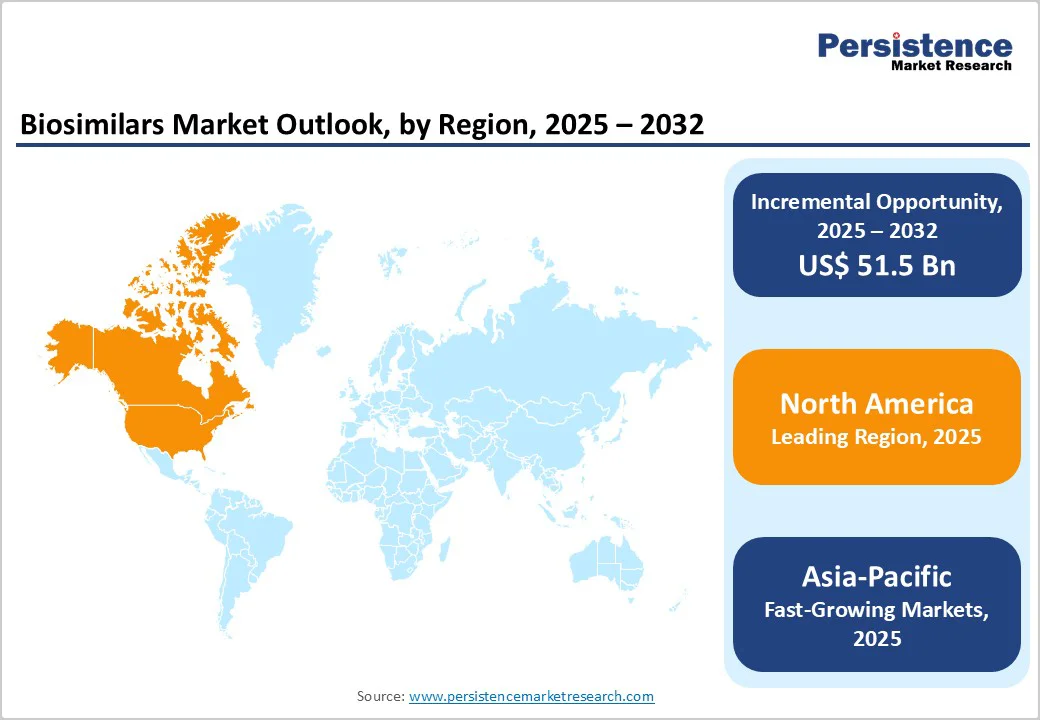
LONDON, UNITED KINGDOM, February 2, 2026 /EINPresswire.com/ -- The global biosimilars market, valued at US$34.7 billion in 2025, is projected to expand to US$86.2 billion by 2032, growing at a compound annual growth rate (CAGR) of 13.9% from 2025 to 2032. The market’s rapid growth is driven by rising prevalence of chronic diseases, expiring patents of high-value biologics, and increasing demand for affordable therapies. While North America leads the market due to strong regulatory support and early adoption, the Asia-Pacific region is emerging as the fastest-growing market, fueled by expanding healthcare access, rising biosimilar adoption, and strengthened domestic manufacturing capabilities.
Download Your Free Sample & Explore Key Insights: https://www.persistencemarketresearch.com/samples/2782
Market Dynamics
A key driver of the biosimilars market is the patent expiration of major biologics. High-value drugs such as Humira (adalimumab), which previously generated over $20 billion in annual sales, lost U.S. exclusivity in 2023, opening the market to multiple biosimilar entries. Similarly, Stelara (ustekinumab), with annual sales exceeding $9 billion, saw U.S. patent expiries in 2023–2024, allowing the first interchangeable biosimilar to launch in 2025. Between 2024 and 2030, more than 60 biologics patents in the U.S. and EU are set to expire, covering therapies in oncology, immunology, diabetes, and rare diseases. These developments create multi-billion-dollar opportunities, stimulate competition, lower treatment costs, and encourage broader adoption across hospitals, specialty clinics, and pharmacy channels.
However, high manufacturing complexity and costs remain significant restraints. Developing a biosimilar typically requires $100–300 million and takes 6–9 years, far higher than small-molecule generics. Production relies on living cells, with minor variations in culture conditions potentially impacting glycosylation, safety, and efficacy. Costs for recombinant protein manufacturing average $300–500 per gram, and stringent quality control adds further financial and technical challenges. These factors limit market entry for smaller players and constrain rapid adoption in some regions despite strong demand.
Market Opportunities
The most lucrative opportunities lie in oncology and immunology biosimilars. With biologics like checkpoint inhibitors and anti-TNF agents approaching patent expiry, oncology represents 61% of the upcoming biosimilar market potential between 2024 and 2028, while immunology accounts for 17%. Oncology biologics made up 51% of the global cancer drug market in 2024, driven largely by monoclonal antibodies. Biosimilars in these areas launch at 10–25% discounts relative to originators and have shown rapid uptake, reaching up to 81% market share within five years of launch, making them highly attractive for manufacturers.
Segment Analysis
Monoclonal antibody (mAb) biosimilars dominate the market with a 46.6% share in 2025. Their high clinical value in oncology and autoimmune diseases, predictable outcomes, and well-established manufacturing processes make mAbs particularly attractive. Over 80 biosimilars targeting 38 reference biologics, including trastuzumab, rituximab, and bevacizumab, are in development. Trastuzumab alone generated over $7 billion in annual sales before biosimilar entry. The high clinical demand, coupled with regulatory approvals in the U.S. and Europe, ensures strong adoption and reinforces the segment’s leading position.
By application, autoimmune disorders account for the largest share of biosimilar use. Top-selling biologics such as infliximab and etanercept have rapidly shifted to biosimilar alternatives, with uptake rates of 93% and 98%, respectively, in markets like Germany. In the U.S., over 20 million individuals live with autoimmune diseases, and annual treatment costs exceed $168 billion. Biosimilars offer cost-effective alternatives, enhancing patient access while reducing financial burdens on healthcare systems. Chronic disease prevalence, long-term therapy demand, and payer incentives make autoimmune disorders the most significant application segment in the biosimilars market.
Get Custom Insights Designed for Your Business: https://www.persistencemarketresearch.com/request-customization/2782
Regional Insights
North America leads the global biosimilars market with a 41.2% share in 2025. The region benefits from clear regulatory frameworks under the Biologics Price Competition and Innovation Act, high biologic usage, and payer-driven adoption strategies. Biosimilars have saved the U.S. healthcare system over $36 billion since 2015, including $12.4 billion in 2023 alone. Aggressive discounts and rising physician awareness continue to accelerate adoption, making North America the dominant market globally.
Europe maintains a strong position due to its mature regulatory environment and proactive adoption policies. The European Medicines Agency (EMA) has approved 86 biosimilars since 2006, ensuring safety and interchangeability. Countries such as Germany, the UK, and France lead biosimilar penetration, with some products achieving over 90% market share of reference biologics. Cost-containment initiatives, tendering policies, and prescribing guidelines drive sustained uptake in oncology, rheumatology, and diabetes segments.
Asia-Pacific is the fastest-growing region, supported by streamlined regulatory pathways, expanding manufacturing capacity, and increasing demand for affordable therapies. China and Japan have standardized biosimilar development, reducing regulatory barriers and accelerating approvals. India, China, and South Korea are rapidly increasing global biomanufacturing capacity, enabling lower-cost production. Rising chronic disease prevalence, expanding healthcare access, and government-led affordability initiatives further position Asia-Pacific as a key growth hub.
Competitive Landscape
Leading companies in the biosimilars market, including Pfizer, Sandoz, Eli Lilly, Amgen, Biocon, and Celltrion, emphasize high-precision manufacturing, robust quality control, and strategic partnerships for global distribution. Sandoz, for instance, launched the biosimilar Tyrukoin in the U.S. in November 2025 and opened a new European manufacturing facility in Slovenia in July 2025, expanding production capacity and global reach. R&D investments focus on monoclonal antibodies and protein biosimilars, supporting efficacy, safety, cost-effectiveness, and growing adoption worldwide.
Checkout Now & Download Complete Market Report: https://www.persistencemarketresearch.com/checkout/2782
Market Segmentation
By Drug Class
Monoclonal antibodies (mAbs)
Erythropoietins (EPOs)
Insulin biosimilars
Growth Factors
Others
By Application
Hematology
Growth Hormone Deficiency
Oncology
Autoimmune Disorders
Diabetes Mellitus
Others
By Distribution Channel
Hospital Pharmacies
Online Pharmacies
Retail Pharmacies
By Region
North America
Europe
East Asia
South Asia & Oceania
Latin America
Middle East and Africa
Read Related Reports:
U.S. Swab and Viral Transport Medium Market: The U.S. swab and viral transport medium market is set to reach US$623.1 Mn by 2032, driven by rising diagnostic needs and healthcare advancements
Cold Relief Roll-on Market: The global cold relief roll-on market will reach US$1,098 Mn by 2032, driven by demand for fast pain relief and growth in OTC healthcare solutions.
Persistence Market Research
Persistence Market Research Pvt Ltd
+1 646-878-6329
email us here
Visit us on social media:
LinkedIn
Instagram
Facebook
YouTube
X
Legal Disclaimer:
EIN Presswire provides this news content "as is" without warranty of any kind. We do not accept any responsibility or liability for the accuracy, content, images, videos, licenses, completeness, legality, or reliability of the information contained in this article. If you have any complaints or copyright issues related to this article, kindly contact the author above.
